
by Jay Sweet
There are jazz composers whose music is unmistakable, and that is certainly true of Charles Mingus. More than four decades after his death, Mingus’s music continues to inspire and remains remarkably contemporary. His compositions draw from the blues, gospel, swing, bebop and modern classical music, yet leave enough room for musicians to improvise and bring their own personalities to the music.
Mingus Big Band Headlining the 2026 Middlesex County Jazz Festival
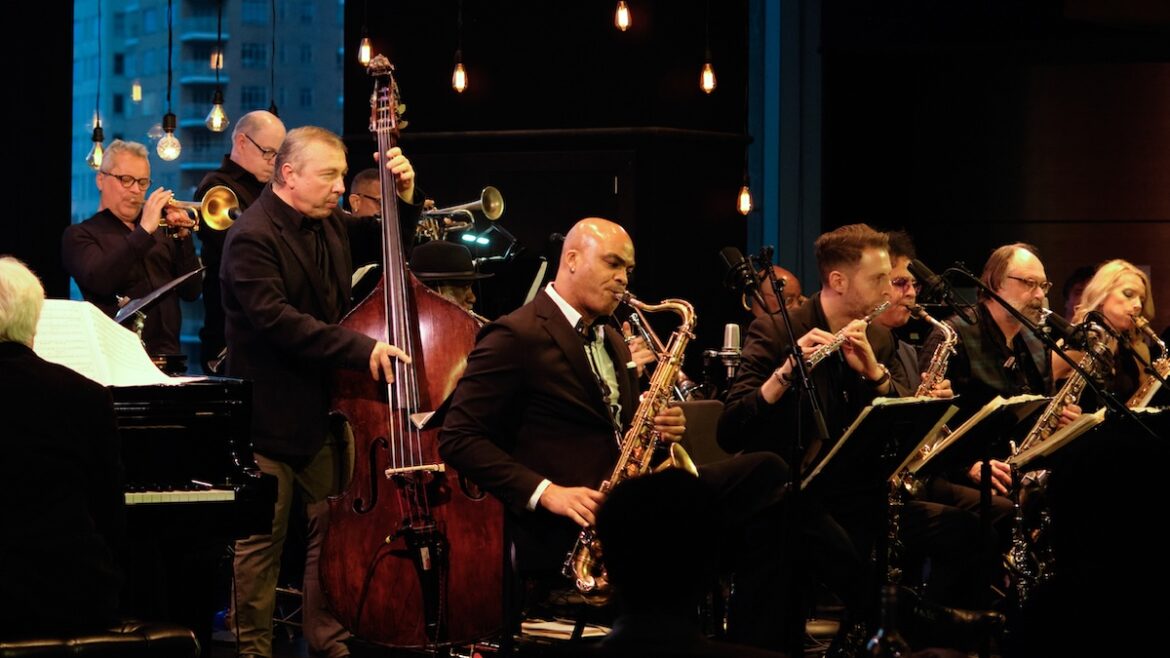
The Mingus Big Band,will bring that music to Central New Jersey under the musical direction of bassist Boris Kozlov as part of the Middlesex County Jazz Festival, which returns September 23–26, 2026. Rather than presenting the festival at one location, the event brings four consecutive days of free jazz performances to Woodbridge, New Brunswick, Carteret, and Metuchen. The Metuchen finale takes place at the 600-seat Metuchen High School Auditorium with the Mingus Big Band closing the 2026 festival from 8:15 to 9:45 p.m. The performances are free, reinforcing the festival’s goal of making live jazz accessible throughout Middlesex County. (More info on www.MiddlesexCountyJazzFestival.org)
Why Boris Kozlov Prioritizes Spontaneity Over Imitation
For Kozlov, the goal is not to recreate Mingus’s music exactly as it existed decades ago. During my recent interview with him, he made it clear that attempting to imitate Mingus would run counter to the composer’s entire philosophy. “It’s absolutely fruitless to try to mimic Mingus, or try to mimic how he did things,” Kozlov told me. That idea—honoring Mingus without imitating him—may be the key to understanding both the Mingus Big Band and why this music continues to thrive.
Kozlov said the Middlesex audience should expect precisely that kind of spontaneity. “Every single person in the band will be featured,” he said. “And it’ll be very uplifting and exciting, I hope.” The band will likely draw material from the recent Charles Mingus Centennial Sessions recordings, but even Kozlov does not necessarily know exactly what will be played until the musicians come together. The Mingus book contains around 150 compositions and arrangements, giving the band an extraordinary amount of music from which to choose. Sometimes older pieces return to the rotation simply because a musician feels strongly about playing one. “Sometimes people have this burning desire” to perform something, Kozlov explained. “We always honor that, because if there’s a desire to play something, that’s like a holy feeling.” The personalities in the band therefore help determine the music rather than being forced into a predetermined recreation of Mingus’s recordings.
The Mingus Big Band was established by Sue Mingus in 1991, building upon the Mingus Dynasty septet she had formed following Charles Mingus’s death in 1979. Today the Mingus legacy includes three primary ensembles: the 14-piece Mingus Big Band, seven-piece Mingus Dynasty and the Mingus Orchestra. Kozlov may serve as the most frequent current musical director, but he does not view himself as replacing either Charles or Sue Mingus. “Mingus is the leader of the band. Sue Mingus was at one point the leader of the band,” he told me. “My role as an MD, I kind of feel it to the point when the band starts wanting a leader. From that point, you take over.” Kozlov describes the ensemble as essentially a collective charged with interpreting what Mingus himself might have wanted.
Boris Kozlov’s Path to Jazz: From the Soviet Union to New York
Kozlov’s own path to Mingus is particularly fascinating because he encountered Mingus’s compositions before he really knew his recordings. Growing up in the Soviet Union, access to American jazz recordings was extremely limited. Musicians copied whatever records they could obtain and shared music among themselves. Kozlov found the Mingus composition “Pussy Cat Dues” in photocopied Real Book material and began playing it without ever having heard Mingus’s recording. “I never heard Mingus,” he recalled. Only after coming to New York did the recordings begin catching up with the compositions. While playing with saxophonist Jake Collins as a street musician Kozlov was told that he needed to know “Better Git It in Your Soul.” He took the advice seriously, went to Fulton Street in Brooklyn and bought a cassette of Mingus Ah Um. The experience was transformative. “When I heard Mingus Ah Um, I realized it’s such a perfect recording on so many levels,” Kozlov said. “You can almost put it in the capsule and shoot it into space for potential representation of…that’s what human jazz is.”
Joining the Ensemble: 14 Phone Calls and the Mingus Play-Along Book
Kozlov’s relationship with the music changed dramatically in 1998, a friend of Kozlov’s, helped connect him with the Mingus Big Band when the ensemble suddenly needed a substitute bassist. Kozlov prepared as much of the music as possible and played the gig, although Sue Mingus was not there that night. When she called and asked him to return the following week, Kozlov was understandably confused. “Ms. Mingus, you haven’t heard me yet,” he told her. Sue’s response was memorable: “I didn’t have to, I made 14 phone calls.” The response from the other musicians had apparently been enough. Kozlov returned the following week, beginning an association with the Mingus organizations that has now lasted nearly three decades.
What happened next says even more about the early confidence Sue quickly placed in him. Trying to better learn the enormous Mingus repertoire, Kozlov asked if there was an Aebersold-style play-along book of Mingus compositions that he could use for study. Sue told him there wasn’t one and essentially responded: Why don’t you make one? “Week two in the band,” Kozlov recalled, “she puts me in charge of producing a play-along.” The project eventually became the Hal Leonard publication Charles Mingus: More Than a Play-Along (Hal Leonard)Within two weeks of entering the band as a substitute, Kozlov had been given responsibility for a project designed to help other musicians study and understand Mingus’s music.
Interpreting Charles Mingus: Playing Bass with His Own Voice
For Kozlov, there is also the unavoidable connection of being a bassist interpreting the work of one of the most important bassists in jazz history. “The main attribute of his playing that impressed me …is the immediacy of delivery,” Kozlov said. “The intent is huge. Like, it has to be played right now, right here, this way.” Kozlov believes that “Mingus’s immediacy of delivery is where no one can touch him.” Yet after extensively studying his playing, Kozlov came to an important conclusion: “I can never sound like Mingus.” Instead, he embraced the lesson passed along by musicians such as Britt Woodman and John Stubblefield, who told him that Mingus demanded musicians develop their own voices. Kozlov decided, “Let me become better myself rather than trying to emulate Mingus.”
Sue Mingus eventually gave Kozlov an extraordinary physical connection to Mingus as well—Mingus’s 1927 Roth bass, which Kozlov kept and played for approximately 12 years. “I sound nothing like him even with the bass,” Kozlov joked. The instrument nevertheless had enormous musical and spiritual significance for him. “The bass itself kind of was teaching me,” he recalled, adding humorously that if he tried too hard to emulate Mingus he felt he might be “struck by lightning or something” in retaliation.
Preserving the Legacy: Sue Mingus and the NYC Jazz Residency Tradition
Any discussion of the survival of Mingus’s legacy bands inevitably leads back to Sue Mingus. She did not simply preserve manuscripts and recordings; she created working ensembles in which the compositions could continue developing. Kozlov says the band has around 150 pieces in its book from a Mingus catalog of approximately 279 compositions, with additional material still waiting to be explored. “It’s an embarrassment of riches, as Sue used to say,” Kozlov told me. Sue also made certain that the musicians did not ignore Mingus’s more ambitious extended compositions, particularly works combining jazz and classical aesthetics.
One of Sue Mingus’s greatest accomplishments was making her husband’s music part of the living fabric of New York jazz. The Mingus Big Band’s residency tradition began with Thursday nights at Fez beneath the Time Cafe in 1991, followed by periods at Joe’s Pub, City Hall and Iridium before reaching what became perhaps its most celebrated home, the Jazz Standard. There, Mingus Mondays became a New York jazz institution and provided a regular laboratory where musicians could continually revisit and reshape the repertoire. When the Jazz Standard closed during the pandemic, the residency tradition survived. The band eventually established a new home at DROM, and in 2026 Mingus Mondays moved to The Pocket Jazz Club in Manhattan, continuing a New York residency tradition now in its fourth decade.
Sue’s death in 2022 inevitably raised questions about whether the Mingus organizations could continue without the person who had driven them for decades. Kozlov says he never seriously believed the bands would disappear. Sue’s withdrawal from daily operations had been gradual, and she made certain knowledgeable people were prepared to continue the work. For Kozlov, however, her death was far more personal. “We lost not only the leader, but a friend,” he said. Kozlov lived close to Sue’s office and remembered her door being almost perpetually open. He could stop by to research Mingus’s files or compare several versions of a composition while preparing an arrangement, and his son practically grew up there. That relationship demonstrates why the Mingus organization is more than a traditional repertory band. There is a direct human connection running from Charles Mingus through Sue Mingus, through musicians who actually played with Mingus, and into musicians such as Boris Kozlov who perform and interpret the music today. Charles Mingus may have left the world in 1979, but his spirit and his music didn’t.
more information on www.CharlesMingus.com/mingus-big-band